Showing posts with label Utilities. Show all posts

Tuesday, October 1, 2019

"Living at 900 Marshy Cove"

"Living at 900 Marshy Cove" 

All residents at 900 Marshy Cove
 have received a copy of this booklet.
A copy has been hung on all doorknobs in the building.  
The booklet addresses our more important 
house rules, policies, and practices.  
It also provides answers to many 
of the typical questions that 
new residents, and potential buyers ask.

Landlords that would like a copy may obtain 
one from a member of the board of directors.
Regards, George Breig


900 Marshy Cove Condominium Association
September 2019 
Printable electronic version available 

on https://900marshycove.blogspot.com


Table of Contents

1. Contact Information 
2. Marshy Cove Emergency Policy 
3. Trash Best Practices 
4. Security Codes and Access 
5. Parking 
6. House Rules 
7. Deep Harbour Pool 
8. Quick Guide to Proper Maintenance 
9. Moving Instruction & Policy 
10. Pet Policy 

11. Frequently asked questions 

Friday, June 28, 2019

Peaking Load Contribution: Electricity Demand Charges

Our Recommendation

We recommend that, whenever possible, you reduce your electricity usage from 3:00 p.m. to 6:00 p.m. Friday, June 28, 2019. Your PLC can influence 10-30% of your electricity bill, so by lowering your PLC this summer you will be able to reduce your PLC and overall electricity costs for a full twelve-month period starting next summer (June 1, 2020, to May 31, 2021).


About PLC

Effective June 1 of every year, each electricity account is assigned a PLC number by its utility. This number is based on the peak usage, which is calculated using five hours from the prior year with the highest PJM system demand, excluding holiday weekdays and weekends. (Note: The selected hours come from five different 24-hour periods.)  Peak usage generally occurs on the five hottest days of the year – and this summer's usage will affect the PLC for next summer.

Tuesday, March 7, 2017

ENERGY: Gas savings February 2017, new heating controls

All, The first results are in the bank. More to come.

Situation:  The space above the garage ceiling contains various pipes for fire suppression and other services.  It is heated by a gas hot air system.

A hard look at our 900 Marshy Cove expense reports showed unreasonably high gas consumption in March, April, and May. Why? It was discovered that the heater was running continually at full blast producing bills of $800-$900 per month.

The original controls installed by Beazer’s contractor were simplistic and eventually malfunctioned.
~~~~~~~~
Pliescott HVAC installed the new heater controls for the garage ceiling on February 2 at a cost of $721.00.
February 2017, 235 units, 8.1 per day, $363.62, average temp= 42, (29 days)
January 2017, 737 units, 22.7 per day, $1096.43, average temp= 41, (33 days)
February 2016, 626 units, 22,3 per day, ---------, average temp= 37, (28 days)
Savings from January(33 days) to February(29 days)= $732.70
 or 22.7- 8.1 units per day = 14.6 units per day or about $20.60 per day
~~~~~~~~~
How it works:
  • A wireless temperature sensor is located in the space above the garage ceiling
  • A second wireless temperature sensor is located in the garage below the ceiling
  • The temperature in the garage must be below 45 degf to enable the heater.
  • If the temperature in the garage goes below 45, the heater works to keep the ceiling space at 65 degf.
~~~~~~~~~
Other costs savings: Elevator Sequence of Operation
Last year, we changed the elevator sequence of operation.
Now the elevators do not return to the lobby after every trip.
Elevator cabs now remain at the last floor until called again.
This eliminated some wait time and empty trips from the lobby.
It was a simple control setting change by Schindler.
Empty trips from the lobby to the upper floors cost energy.
We haven’t been able to determine the energy savings yet, but, it is there.
There should also be some maintenance savings over the long term.

~~~~~~~~
We are also changing all light bulbs in the building to LED's.  All of the hallway wall lamps were previously replaced with LED's saving us approximately $5000 per year.
~~~~~~~~~~~

Regards, 900 Marshy Cove's Board of Directors


Wednesday, November 16, 2016

President’s Report, November 12, 2016

900 Marshy Cove Condominium Association

President’s Report, November 12, 2016

George B

Overview of 2016:
This year began with a successful campaign to limit investment ownership within our building. Bylaw changes are difficult as they require a 67% affirmative vote. Two amendments were passed that limit rentals to 20 of the 48 units, and limit ownership to two units per entity.  This should secure our owners’ financing options and maintain the character of our building for all.

In May, at the Annual Meeting of Members, Alan Mc accepted the open director position. Officers were elected by the directors. 
  • ·         President: George B, Unit 408
  • ·         Vice President: Jan S, Unit 410
  • ·         Treasurer: Leo E, Unit 209
  • ·         Secretary: Shirley M, Unit 207
  • ·         At large: Alan Mc, Unit 202
  • An annual plan to schedule regular maintenance and events has been develop for 2017 and beyond.  The schedule will guide regular events and to communicate expectations to Sentry Management.
  • A three year plan will be published to schedule major replacement projects that will be financed according to the Reserve Plan. Painting, carpeting, and safety will be on the list.
  • 2016 presented 900 MC with several challenges. Two major maintenance issues stressed our operating budget. The financial burden by the following unbudgeted expenses were offset partially by an improvement in utilities cost. Deck repairs will also impact our finances in 2016 and continue into 2017. Our utilities expense should continue to improve with the addition of insulation to the garage ceiling.
  • Finances: 900 Marshy Cove is in great financial health. All condo fees are current, Our reserve funds are on schedule. We will have unplanned expenditures; but, the Association is well positioned to handle these challenges.

Major expense issues:
  • ·         Fire Suppression System: The dry sprinkler system which protects the area about the fourth floor continued to leak air causing persistent “trouble” alarms.  Although, we were protected, the air leaks caused rapid cycling of the air compressor located in the attic space. This problem first surfaced in 2015.  The air leaks have been identified and repaired. The compressor had to be replaced as it failed due to overloading.  Repairs costs $8,206 over and above regular maintenance.
  • ·         Roof repairs: A persistent leak on the roof over Unit 410 was repaired by replacing a section of warped board. It was covered with underlayment and new shingles. The cost of this unbudgeted work was $4,582.
  • ·         Deck repairs: Obtaining a reasonable bid has been a challenge.  Bids ranged from $250 to $4,400 to $14,000. We have issued a work order to repair two decks as a pilot.  If successful, we will issue and work order for the remaining 26. Although the low bid does not conform to the manufacturer’s recommendations, it is felt that it will be durable enough to last several years. 

Minor unbudgeted expenses:
  • ·         Garage Doors: Several failures occurred this year. Broken springs, key pad damage, and keypad failure added minor costs.  Some these costs were offset by reimbursement.
  • ·         Air ducts: Vent ducts for the first floor were cleaned of bird nests. Ducts were sealed to prevent re-entry on all exterior vents. Costs $1850
  • ·         Front doors: After a bike theft, the magnetic door locks were strengthened.

Other mentionable budgeted items:
  • ·         Garage deck: This year we contracted an industrial cleaning company to scrub our garage deck to remove embedded stains.  Previously, the deck was power-washed.
  • ·         Hallway carpets: In August, our hallway carpets were scrubbed, it is evident that our carpets are nearing the end of their life.  Deep stains continue to re-surface. Some are to beginning to see rippling and wear. Pets and trash bags drippings are the culprits.
  • ·         Landscaping & Gardening: Our front yard has improved. Despite adding irrigation and soil improvement, several plants have withered.  The landscaping committee has met with Kyle Marshall to clean up some areas around the building and will be making more improvements in 2017.  The committee will be hiring a separate gardener if desirable.
  • ·         Insurance: Many thanks to our Vice President for negotiating a 6.2% reduction on our insurance.

Other Improvements and mentionable items:
  • ·         Garage ceiling Insulation: To our surprise Beazer hired a contractor to install insulating above the drop ceiling in the garage at no cost to us. The space contains some plumbing that could be subject to freezing. The space is heated by a gas heating system paid for by the 900 MC Association.  The heated space supplements the comfort of the first floor as stated in the design specifications.  We expect to see the benefit over the winter months.  Hopefully, the first floor units ill d also see a reduction in the gas bills.
  • ·         Elevator operation: The elevators were programmed to hold at the last floor exited rather that return to the lobby.  Some reduction in electricity consumption is expected.
  • ·         Annual inspections: Our annual smoke alarm battery replacement program has been augmented to include checking on expansion tanks.  Last year, three defective expansion tanks were discovered and replaced.
  • ·         Pets &  Pet Committee: This year Sentry failed to assess pet owners the $25 annual pet fee.   In 2017, the fee will be assessed in the January letter to owners. The letter will include the proper forms to register pets with 900 MC.  Expect an increase in the registration fee.
  • ·         Advisories: a plan to advise owners on maintenance issues and other helpful messages have been and will continue be posted on the 900 Marshy Cove web site. Elevator Notices also updated with suggestions to avoid problems and offer solutions.
  • ·         Internet links: These sites will provide information about tour community.


Deep Harbour Master Association
  • ·         Beazer has settled a long standing debt of $66,000 with the DHMA.  The money will be used to fund reserves and operating balances.  A committee is reviewing the reserve plan and how to distribute the money.
  • ·         The Beazer owned property known as TH4, and the unfinished properties of TH3, and TH5 are now subject to a Tax Lien by the city of Cambridge. This was noted in the city council Minutes of September 12, 2016.  The DHMA Board of Directors has engaged Cowie & Mott to advise us on the impact that this may have on Deep Harbour.  The Tax Lien does not pertain to any privately owned property or the property commonly owned by the DHMA.
  • ·         Beazer plans to “top coat” the unfinished streets in DH.  They are responding to a DNR run-off remediation issue. No dates have been set.
  • ·         Street lights have been failing at a high rate. The new LED’s were installed without surge/lightning protection devices.  It is believed that this may have caused our high failure rate.  All new bulbs and old bulbs will include surge protection. DHMA has absorbed most to the cost of replacement after the installer refused to replace all of the bulbs.  LED bulbs should last longer than HID and consume 75% less electricity.
  • ·       The YMCA successfully manage the DH pool in 2016.  They will be asked to bid again in 2017.
  • ·         A DH landscaping committee has been formed. Each sub-association will be represented.
  • ·         Parking remains a problem within DH. Commercial Vehicles are not permitted as stated in our bylaws and Parking Policy.  New Maryland towing laws have complicated penalties.
  • ·         Personal gate codes were eliminated and replaced with one code.  Many remotes were accidently disabled during the download process. This appears to have been corrected.


Stay informed.  

Send your comments to MC900@comcast.net

Friday, July 29, 2016

How to save on your Delmarva Electric Bill

Many of you may already know about this program. My unit has been on this program for 3 summers.  You will never notice the difference.

Most peak periods occur during week days on the hottest days of summer.
I recommend the exterior control box called a Digital Cycling Unit (DCU).


Shave $30 to $80 off your Air conditioning bill.

Watch the video.  https://energywiserewards.delmarva.com/md/index.php 

Energy Wise Rewards is a tool for Maryland customers to take more control over your energy usage, save money on your energy costs, and take a big step towards a more sustainable lifestyle.

Demand for electricity in Maryland is rapidly rising. During the "peak demand" times of summer, Energy Wise Rewards works to reduce electricity usage by "cycling" central air conditioners throughout the region, averting power outages, and reducing the need for costly, new electrical infrastructure.
There are no hidden costs or fees, and the program is completely voluntary. Because your participation is so important, we are offering this critical program at no charge, complete with valuable incentives. Joining is a choice that not only benefits you personally, but benefits your community and environment as well.
Enroll now by choosing your participation level and energy-saving device. You'll receive a one-time installation credit, Monthly Reward Bill Credit, and your choice of Energy-Saving Devices at no charge!

LEARN MORE:


send you comments to mc900@comcast.net

Wednesday, June 1, 2016

Annual Service for your Air Conditioning System, 2016

The units at 900 Marshy Cove and 700 Cattail Cove should to be serviced every year.

  • In June, you should pour a cup of bleach down the condensate drain.
  • Spring and Autumn are good times to change your air filter.

During the season, condensation from the coiling coils can support the growth of "biological crud" in the drain. The bleach should clear any developing blockage. Failure to clear a blockage will result in an overflow and potential water damage to your unit and units below.

How it works: (This description varies with your condo floor plan.)

  • Your air conditioning system has three primary components:
    • The  Compressor which is in the garage or outside
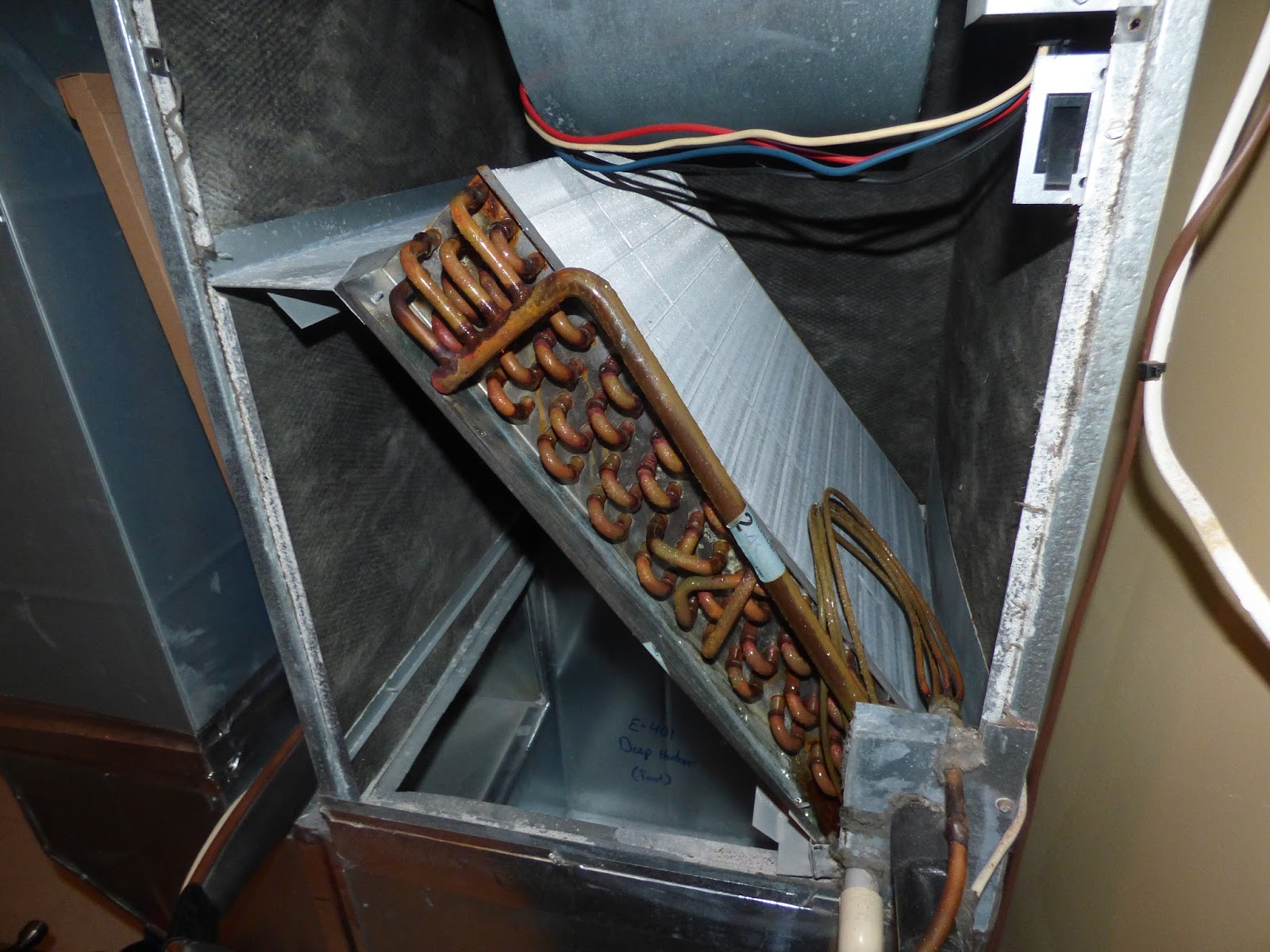
    • The Coiling Coil also called the Evaporator Coil in your duct work located in your laundry room or utility closet.
    • The tubing that connects the two units
Primary drain is on the right. note trap at  bottom that where crud builds up. The left pipe is the overflow.

Remove cap. Slowly pour the bleach in here. 

  • The condensate drain pipes are located in your unit in your laundry room or utility closet
    • There are two white PVC pipes coming out of the duct work. (see photos)
    • One is the primary condensate drain. Its purpose is to drain the condensed humidity away and out of your unit and out of the building. It has several bends and an access cap.
    • The second pipe is a back-up or overflow drain which directs excess water to an overflow pan at the bottom of the duct assembly. If you see water in this visible pan, you have a problem with your primary drain. 
    • The back-up pan has a float switch which should shut down your system if it is full. 
  • The copper tubes that connect both units run through the building, Under normal operation, one is hot and one is cold. A pin-hole leak may mean full replacement.  Usually these lines are durable enough to last for years. Most leaks occur at the connections. 
Simple checks: Do this on a warm day
  • Turn your conditioner on. Set the thermostat a few degrees lower. Are you getting cool air blowing out of your registers? Check your room temperature, It it going down? How long does it take to get to the cooler setting. use a good thermometer to check.
Ceiling register
  • Find your compressor in garage or outside. They are labeled. The fan should be blowing warm to hot air. That's the heat the AC is removing from your unit. Compare with other operating compressors. If the air is cool, you may have a problem.
Solutions:
  • The unit owner is responsible for the maintenance and repair of all air conditioning equipment.
  • You may select any HVAC service company.
  • We have experience with Black Water Heating and Air Conditioning, 
    • 4364 Egypt Rd., Cambridge, MD 21613, (410) 221-0180
  • Standard service should be less than $100.  Full recharge of gas up to $300.
  • Contact Sentry Management if you need more assistance. (410)221-0398
  • Get a good thermostat. The Trane thermostats that Beazer installed are mediocre (cheap). Honeywell makes the best on the market. Use time schedules to save money. 
Electronic Thermostat. 
  • When you leave the unit do for an extended period in the summer, set the AC to 78-80. It will minimize humidity. 
  • Subscribe to the power companies "peak savings program". Have them put the "peaking switch" on the AC unit. Using their thermostat can affect heating. One winter, they shut off our heating units of course by accident. That was fun.
  • For the handy man: The best check is to check the coil box temperature. Open it up, insert a thermometer, then close it. Let the unit run for 10 minutes, then remove the thermometer. 55 degrees or less is good. I use a radio remote thermometer which you can buy at Radio Shack or most hardware stores.
The inner workings. This is the cooling coil. This chamber should be 55 degrees or less.
Stay Cool, Uncle George

Sunday, February 14, 2016

900 Marshy Cove Saves Energy and MONEY with LED Lighting Replacement

Here are the metrics on electricity savings since LED lighting was installed in the common areas of 900 Marshy Cove in the Spring of 2015.

This is quite a chunk of change. These data were sourced directly from the Delmarva Power web site.  The data speaks for itself.


WOW! $4691.67 saved over 11 months.
(Please note that other equipment is also serviced on this circuit therefore the seasonal variation.)


Many Thanks to Sentry Management for discovering and moving on this opportunity for our building. 

Send your comment and ideas to mc900@comcast.net

Monday, December 21, 2015

Expansion Tanks. Results of Unit Inspections.

On Tuesday, December 15, 2015, expansion tanks were checked in each unit at 900 Marshy Cove.
At least three units were in need of replacement.
Each owner was contacted and all plan to replace their tanks.

Here are some photos of one of the tanks.
WOW! ANY DAY NOW!


It is recommended that these tanks are replaced every 4-5 years.

Questions? 
Contact Sentry 


Monday, December 14, 2015

Reminder! Tuesday, December 15, 2015: Balcony and Expansion Tank inspection

Starting at 8:30 AM, Sentry management will be examining balcony deck coverings for deterioration.

Water heater Expansion tanks will also be checked for any visible deterioration.

These checks will only take several minutes. Be sure to point out any structural issues that may be of concern.

Early detection of problems will help us avoid more serious damage in the future.

Residents should make a note for yourself as a reminder.

Sunset on the creek
Send your questions to mc900@comcast.net


Tuesday, February 10, 2015

Water Heater: More information on how it works.

Information on our water heaters:
This is a story about your water heater and how it works.

Let's start with the main water shut-off. Do you know where yours is located? Look in you utility room. You should see a square access cover a near eye level. If you pull on it, the shut-off valve is revealed. Knowing where it is and how to close the valve could save you hundreds of dollars of water damage.

To shut off all of the water to your unit, turn it perpendicular to the pipe. The one below is shown OPEN.


Our next stop is the water heater. the water heater does two jobs. It supplies hot water to your spigots and also recirculates water to a heating unit located in your utility room.

Your heating unit is a hot water fan-coil unit located in the duct-work in the utility room. Fan-coil means exactly that. A fan blows air across the hot water coils and forces it through the ducts to your room registers. The same fan also blows air across another coil used for air conditioning in summer.

The water heater in your closet heats the water and maintains the tank temperature all year long. The water temperature can be adjusted but it really only affects the recirculated water that flows to the fan-coil unit. Gas is used to heat the water.


On the tank, you will see the recirculate inlet and outlet connection on the right hand side.


On the top you will find the cold-water inlet and hot-water outlet. SHut valves can be used in summer to prevent hot water going to the heater coil.

A high pressure relief valve is located on the front. Its job is to prevent the tank from erupting in case of a control malfunction. The plastic pipe leads the water down to a catch pan that is expected to minimize flooding in the event of a malfunction. NEVER stopper the relief pipe.

The temperature of hot water in the recirculating tank can be adjusted from the front control display. (OK, ask somebody if you're not sure that you know what you're doing.)

(This will not make your spigot water hotter. I'll get to that later.)

Find the operator manual. read it. .......

Now that you have read the manual, check the current setting. Press, both the "HOTTER" and "COLDER" at the same time, now you can adjust the RECIRCULATING WATER TEMPERATURE. Chances are you do not need to change it. Unless you are unhappy with your heater's response, you should not touch it.  You can lower the setting in summer. Please note, that it need not be higher than A. Someone in the building had it adjusted it to "C" and the heater popped its high pressure relief valve. Water. water, everywhere.

Recirculating water temperature control: It controls water that goes to the heater and the holding tank.


The hot water temperature for you spigots is controlled by MIXING VALVE above the water
heater.
 Since the water exiting the heater is too hot for skin contact, it is mixed with cold water. On one side cold water enters. On the other side, hot water enters from the water heater. The water that exits the mixing value is delivered to your spigots, shower heads, and washing machine. In most municipalities these safety mixing valves are required by code.

The spigot water temperature can be adjusted by turning the knob on the valve. Any adjustment should be made in small increments. This device is meant to prevent burns. Once again, read the manual.


HOT = Copper left

COLD = Copper Right

Hot Tap Water = Bottom to plastic pipe


Expansion Tank

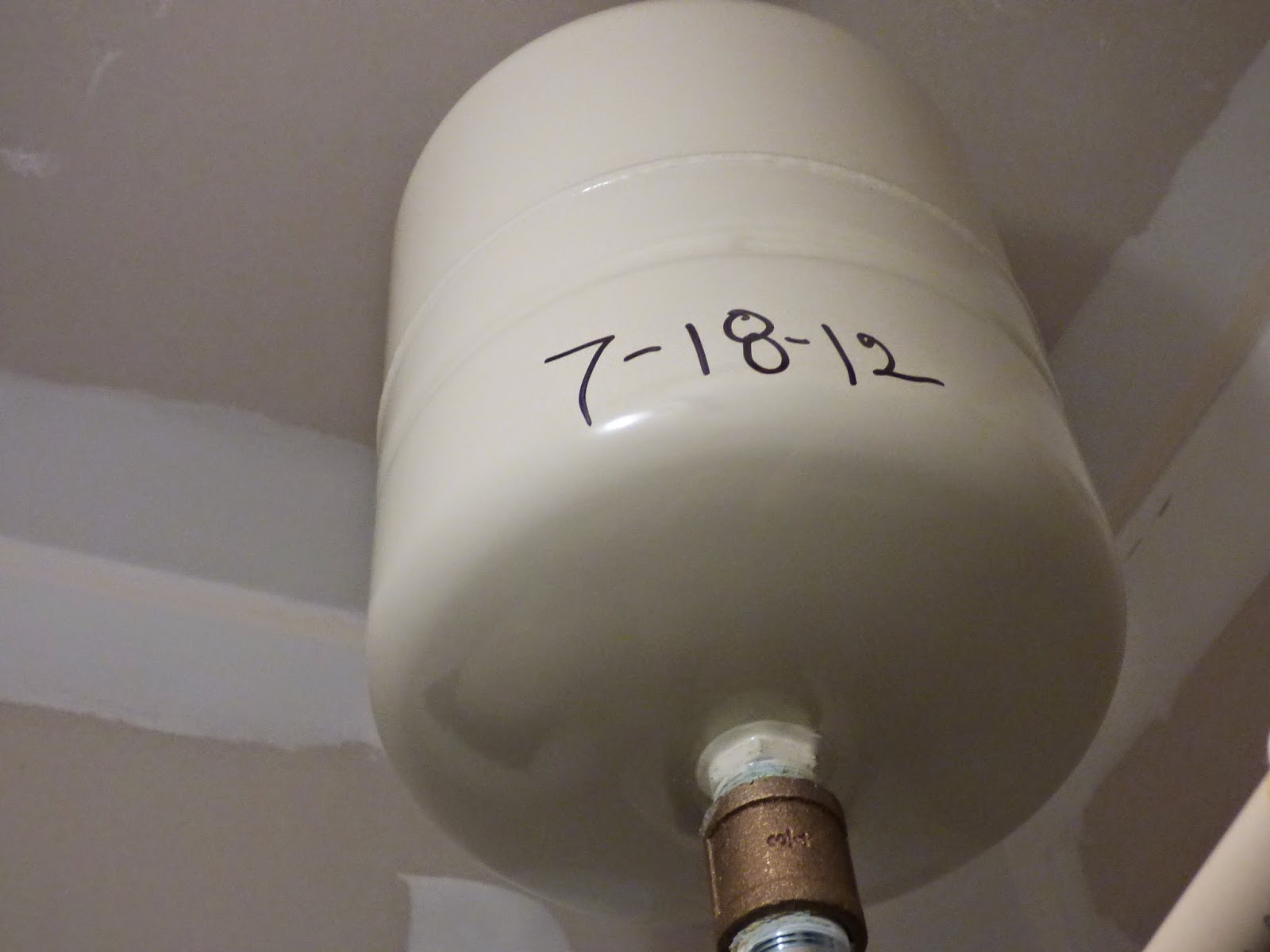
This is the weakest link in the system.  This is a simple and inexpensive device. It purpose is to accommodate the expansion of the water and trapped air in the recirculating water lines.  Why it leaks after several years speaks to the quality of the tank's lining.  The tanks is easily replaced. Screw it off, screw on a new one.


This is mine,  Good for another two years, I hope.

Safety Concerns with Natural Gas:

Lastly, remember that we are burning gas all year long for hot water and heat in the winter. Gas is safe if all of the equipment is in proper working order. Your heater is equipped with a flame-safeguard control that will shut-off the gas is the flame is lost.


Go one step further, get a Carbon-Monoxide Gas Detector. Locate it nearby the water heater closet. Many people are asphyxiated by malfunctioning gas furnaces every year.

Best Regards, Uncle George


Send you letters to mc900@comcast.net


When will yours fail? The clock is ticking!

Below are photos of expansion tanks that were replaced after springing leaks.

Just this past week, the owner of Unit 104 had no heat.  Why? Because a slow leak from their expansion tank was dripping on the electronics atop the main tank. These folks were lucky.
They only had to replace their heater.  The complication is that the installed A.O. Smith Promax heaters have been discontinued. No replacement parts are available.  Cost? about $3000

On a previous failure, a leaky expansion tank caused damage to the owner's unit and the units below. Guess who was liable?  Yes, the unit owner with the leak.

In July, 2012, replacement service was offered. Not everybody took advantage.  The cost was under $200.  Talk about an ounce of prevention! 

Mid Shore Plumbing has provided pictures of expansion tanks they removed previously. You will see from the photos that these tanks could have burst at anytime. This is even more of a reason for each and every owner to replace theirs. It was also recommended that these tanks be replaced every four years as a precautionary measure.
For replacement, contact Mid Shore Plumbing directly at 410/228-9003. They will not be available until February 23, 2015; but, you can leave a message.
~~~~~~~~~~~~~
Do not take this advice lightly.  A penny today can save a dollar(s) tomorrow............................


This is mine. I believe that it is good until 2016. 
Tick...tick..tock...Drip...drip....drop

Send your comments to mc900@comcast.net

Monday, January 12, 2015

Is your Electric Meter correct?

Recent History
Several months ago one unit owner discovered that they were paying someone else's bill.
It appears that the meters were mislabeled. You might say the wires were crossed. This had been on-going since inception.  It was only discovered when Delmarva Power shut-off the electricity to one unit and the other unit went dark.  It took several hours for an electrician to figure out the cross over.

Questions:  
Are any other meters linked to the wrong units?
Are you paying for your electricity?

You can check yourself.
The last page on your paper bill should have a daily usage chart. Check the bars on the days that you were in your unit verses days that you were away.  If it coincides then you are probably OK.

If you are a techy type you can go to the Delmarva website.
  •  If you haven't been there, you will have to register to create a login.  It will take a little time but, you can access account information also.
  • Go to the Delmarva web site and look at your daily usage. It should follow your occupancy pattern.  If you are a weekender, it should be easy to see higher consumption on Saturdays and Sundays.  Full time residents can look for vacation or travel days.
  • https://webapps3.delmarva.com/login/delmarva/
  • Select "Energy Use and Bill Data"; Select "My Usage"; then select "Daily Energy Use"
You will see a chart that looks like this:

Note 12/13 and 12/14.  We were traveling those days and our bill reflects that.  It appears that the meter readings match our occupancy (Only the refrigerator was running.)

If you like, you can scroll back to the summer months to look at your air-conditioning loading.

Remember that this is not heating.  Our heat is Natural Gas.

Send your comments to mc900@comcast.net

Tuesday, January 26, 2010

How it works: your Water heater

This is a story about your water heater and how it works.

Let' start with the main water shut-off. Do you know where yours is located? Look in you utility room. You should see a square access cover a near eye level. If you pull on it, the shut-off valve is revealed. Knowing where it is and how to close the valve could save you hundreds of dollars of water damage.

To shut off all of the water to your unit, turn it perpendicular to the pipe. The one below is shown OPEN.


Our next stop is the water heater. the water heater does two jobs. It supplies hot water to your spigots and also recirculates water to a heating unit located in your utility room.


Your heating unit is a hot water fan-coil unit located in the duct-work in the utility room. Fan-coil means exactly that. A fan blows air across the hot water coils and forces it through the ducts to your room registers. The same fan also blows air across another coil used for air conditioning in summer.

The water heater in your closet heats the water and maintains the tank temperature all year long. The water temperature can be adjusted but it really only affects the recirculated water that flows to the fan-coil unit. Gas is used to heat the water.

Hot water from the tank is mixed with cold water to reduce the temperature for safety. 


On the tank, you will see the recirculate inlet and outlet connection on the right hand side. There are two shut valves which can be used in summer to prevent water flowing to the heating coil


On the top you will find the cold-water inlet and hot-water outlet.

A high pressure relief valve is located on the front. Its job is to prevent the tank from erupting in case of a control malfunction. The plastic pipe leads the water down to a catch pan that is expected to minimize flooding in the event of a malfunction. NEVER stopper the relief pipe.

The temperature of hot water in the recirculating tank can be adjusted from the front control display. (OK, ask somebody if you're not sure that you know what you're doing.)

(This will not make your spigot water hotter. I'll get to that later.)

Find the operator manual. read it. .......

Now that you have read the manual, check the current setting. Press, both the "HOTTER" and "COLDER" at the same time, now you can adjust the RECIRCULATING (TANK) WATER TEMPERATURE. Chances are you do not need to change it. Unless you are unhappy with your heater's response, you should not touch it.  A lower stting canbe used in the summer since it is for tap water only. Please note, that it need not be higher than A. Someone in the building had it adjusted it to "C" and the heater popped its high pressure relief valve. Water. water, everywhere.

Recirculating water temperature control: It controls water that goes to the heater and in the holding tank.


The HOT water temperature for you spigots is controlled by MIXING VALVE above the water heater. Since the water exiting the heater is too hot for skin contact it is mixed with cold water. On one side cold water enters. On the other side, hot water enters from the water heater. The water that exits the mixing value is delivered to your spigots, shower heads, and washing machine. In most municipalities these safety mixing valves are required by code.


The spigot water temperature can be adjusted by turning the knob on the valve. Any adjustment should be made in small increments. This device is meant to prevent burns. Once again, read the manual.


Lastly, remember that we are burning gas all year long for hot water and heat in the winter. Gas is safe if all of the equipment is in proper working order. Your heater is equipped with a flame-safeguard control that will shut-off the gas is the flame is lost.


Go one step further, get a Carbon-Monoxide Gas Detector. Locate it nearby the water heater closet. Many people are asphyxiated by malfunctioning gas furnaces every year.

Best Regards, Uncle George


Send you letters to mc900@comcast.net